Losing a tooth changes more than your smile. You notice it when you chew, when you speak, and sometimes when you catch yourself avoiding photos or covering your mouth while laughing. If you are weighing missing tooth replacement options, the right choice depends on more than appearance. Comfort, long-term health, budget, and your daily routine all matter.
Some people want the closest thing to a natural tooth. Others want the simplest way to restore function without surgery. There is no one-size-fits-all answer, which is why a good treatment discussion should feel clear and personalized, not rushed or overly technical.
Why replacing a missing tooth matters
A gap in your smile can seem manageable at first, especially if it is near the back. But over time, a missing tooth can affect the teeth and bone around it. Nearby teeth may start to shift into the space, which can change your bite and make cleaning harder. The opposing tooth can also drift because it no longer has contact.
There is also the issue of jawbone support. Tooth roots help stimulate the bone. When a tooth is lost, that stimulation decreases, and the bone in that area can gradually shrink. This is one reason replacing a tooth sooner rather than later often gives you more options.
Function matters too. Even one missing tooth can change how evenly you chew, and that extra strain can end up on other teeth. If the missing tooth is visible, confidence often takes a hit as well. For many patients, replacing the tooth is about feeling like themselves again.
Missing tooth replacement options at a glance
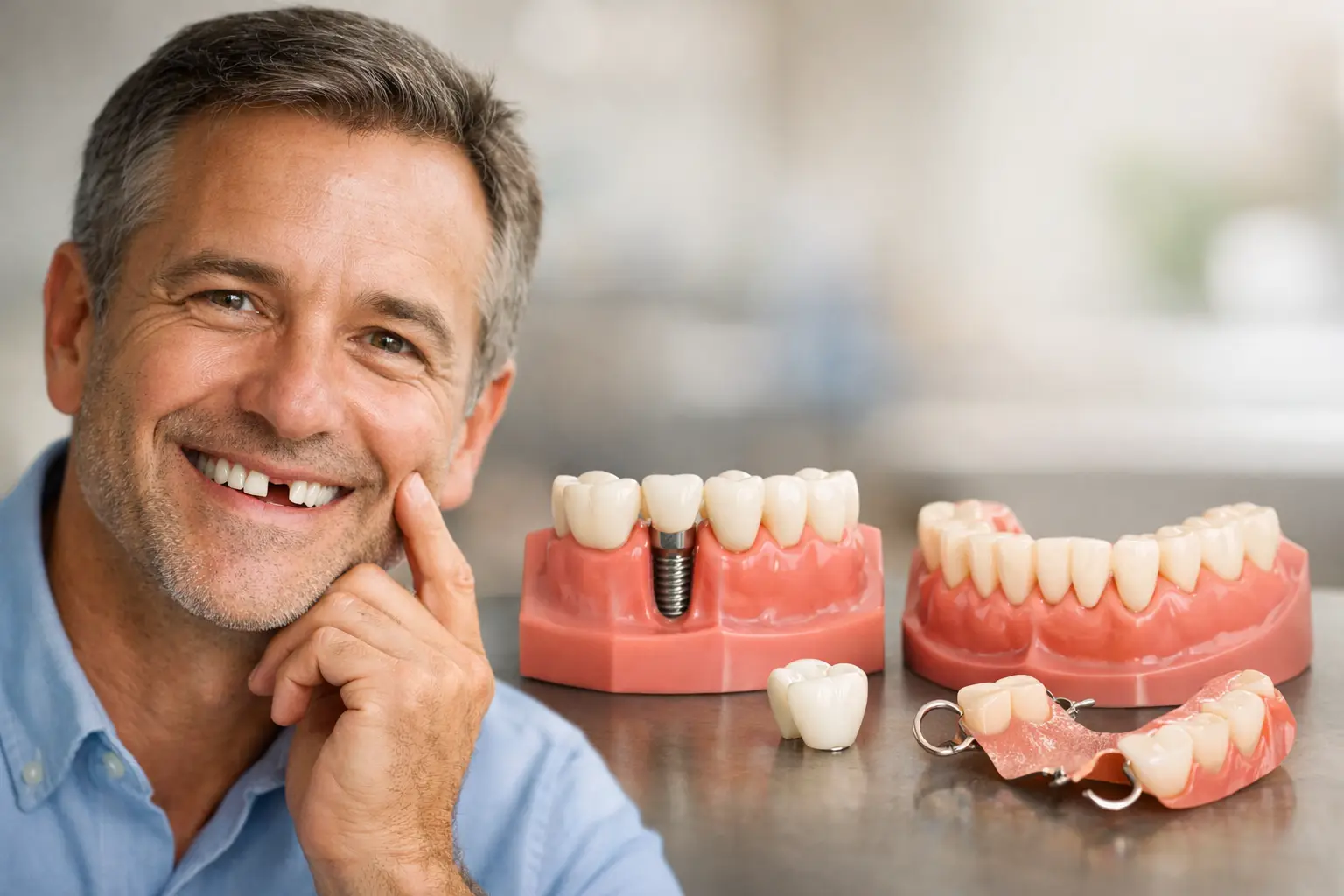
The three most common missing tooth replacement options are dental implants, dental bridges, and dentures. Each can restore chewing and improve appearance, but they work in very different ways.
Implants replace the tooth root as well as the visible crown. Bridges use nearby teeth for support to fill the space. Dentures are removable replacements that can restore one tooth, several teeth, or a full arch. The best fit depends on your oral health, bone support, number of missing teeth, and what you want from treatment.
Dental implants
Best for long-term stability
A dental implant is a small titanium post placed into the jawbone where the missing tooth used to be. After healing, a custom crown is attached on top. The result is designed to look, feel, and function much like a natural tooth.
For many patients, implants are the closest thing to getting the tooth back. Because the implant integrates with the bone, it helps preserve bone structure better than other options. It also does not rely on neighboring teeth for support, which is a major advantage when the teeth beside the gap are healthy.
What patients like about implants
Implants are popular because they feel secure. You do not remove them at night, and they do not usually shift while eating or talking. They also tend to be easier to clean than a bridge because you can brush and floss around them much like a natural tooth.
From a cosmetic standpoint, implants can look very natural. If the tooth is in a visible area, that can make a meaningful difference in confidence.
Trade-offs to consider
Implants are not the fastest option. The process often takes several months because healing time is part of the treatment. Some patients also need bone grafting before implant placement if there has already been bone loss.
Cost is another factor. Implants usually have a higher upfront cost than bridges or dentures. That said, they can be a strong long-term value because of their durability and the way they protect surrounding structures.
Implants also involve a surgical procedure, which can make some patients nervous. A comfort-focused office can help a lot here, especially if sedation options are available for anxious patients.
Dental bridges
Best for replacing one or a few teeth without an implant
A bridge fills the gap by attaching an artificial tooth to the neighboring teeth. In a traditional bridge, the teeth on either side are prepared for crowns, and the replacement tooth sits between them.
Bridges are a well-established option and can be a very effective way to restore a smile. They are often chosen when a patient wants a fixed solution but is not ready for implant surgery or does not have enough bone support for an implant.
Why a bridge may make sense
Treatment time for a bridge is often shorter than for an implant. In many cases, the restoration can be completed in a matter of weeks rather than months. Bridges also avoid surgery, which some patients prefer.
A bridge can work especially well if the neighboring teeth already need crowns. In that situation, preparing those teeth may fit naturally into the overall treatment plan.
Trade-offs to consider
The main downside is that a traditional bridge depends on the teeth next to the gap. If those teeth are healthy and untouched, reducing them to support a bridge may not be ideal. Bridges also do not replace the tooth root, so they do not provide the same bone-preserving benefit as an implant.
Cleaning under a bridge takes a little extra effort. Your dentist may recommend floss threaders or other tools to help keep the area healthy. With good care, bridges can last many years, but they do require attention.
Dentures
Best for flexibility and affordability
Dentures are removable appliances that replace missing teeth. A partial denture replaces several missing teeth while using the remaining natural teeth for support. A full denture replaces all teeth in the upper or lower arch.
Dentures have come a long way in comfort and appearance. For many people, they offer a practical and affordable path to restoring function, especially when multiple teeth are missing.
When dentures are a good option
If you are missing several teeth, a partial denture may restore chewing and appearance without the cost of multiple implants or extensive bridgework. Full dentures can also be life-changing for patients with widespread tooth loss or advanced dental problems.
Dentures are generally less invasive and often more budget-friendly than fixed options. They can also be made more quickly, which matters when restoring your smile cannot wait.
Trade-offs to consider
Because dentures are removable, they tend to feel different from natural teeth. Some patients adapt quickly, while others need time to get used to them. Lower dentures in particular can feel less stable than upper dentures.
Dentures also do not stimulate the jawbone the way implants do, so bone shrinkage can continue over time. As the shape of the gums changes, dentures may need adjustments or replacement for a proper fit.
For patients who want more security, implant-supported dentures can offer a middle ground. These use implants to help hold the denture in place, improving stability while replacing multiple teeth.
How to choose between missing tooth replacement options
The best treatment starts with a clear exam and honest conversation. Your dentist will look at the condition of your gums, the health of neighboring teeth, your bite, and the amount of bone in the area. Just as important, they should ask about your priorities.
If you want the most natural feel and long-term bone support, an implant is often worth considering first. If you want a fixed option without surgery, a bridge may be the better fit. If you need to replace multiple teeth in a more affordable way, a partial denture or full denture may make the most sense.
Budget matters, and it is okay to say that upfront. So does dental anxiety. A treatment plan only works if it feels realistic for your health, schedule, and comfort level.
Timing matters more than many people realize
It is common to put off treatment after losing a tooth, especially if life gets busy or the gap is not visible. But waiting can make replacement more complicated. Teeth can shift, bone can shrink, and what might have been a straightforward implant case can become one that needs additional procedures.
That does not mean you have missed your chance if time has passed. It simply means an evaluation is the best next step. Many patients still have excellent options, even years after tooth loss.
What to expect at your consultation
A good consultation should leave you feeling informed, not pressured. You should understand what each option can do, what it cannot do, how long treatment may take, and what kind of maintenance is involved.
If you are nervous, say so. That matters. A welcoming dental team will explain things clearly, move at a pace that feels manageable, and talk through comfort options if needed. At Burnaby Square Dental, that patient-first approach is a big part of helping people move forward with care they may have been postponing.
Choosing among missing tooth replacement options is not about picking the most advanced treatment on paper. It is about finding the option that restores your smile in a way that feels right for your health, your budget, and your peace of mind. If you are unsure where to start, start with a conversation. The right plan often becomes much clearer once someone takes the time to look at your smile and listen to what matters to you.